

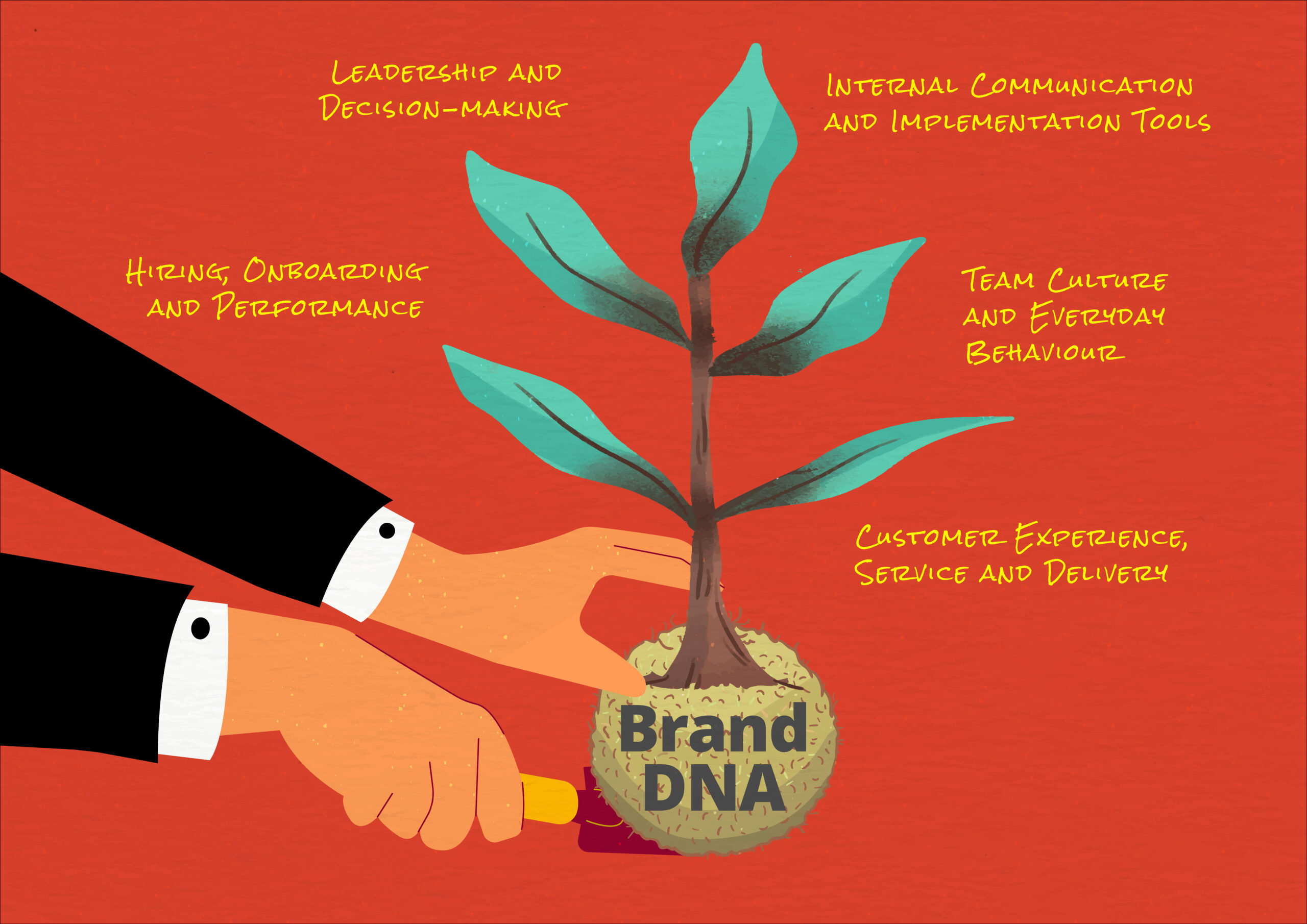
If you want a stronger, more consistent brand, Brand DNA cannot live only in a workshop, slide deck or guideline document. It must show up inside your business, in the way you lead, hire, communicate and deliver.
This is where many brands lose momentum. They invest in design, messaging or campaigns, but the internal business remains disconnected. Leadership makes off-brand decisions. Teams interpret the brand differently. Customer experience becomes uneven.
The result is a brand that looks polished on the outside, but feels unclear in practice.
At EQ Brand, we have seen this across more than three decades of brand consultancy work in Singapore and beyond. Since 1994, we have helped brands across more than 20 countries, from regional airlines like Manta Air to cultural institutions like the National Gallery Singapore, align who they are with how they show up. Our view is simple: a brand becomes valuable when it is lived, not just described.
That is exactly what Brand DNA is for.
Key Takeaways:
- Brand DNA only creates value when it shapes how your business leads, hires, communicates and delivers, rather than sitting unused in a deck or guideline.
- A strong Brand DNA gives your organisation clarity by aligning leadership decisions, team behaviour, internal tools, and customer experience around a single shared direction.
- When Brand DNA is not embedded, businesses often see mixed messages, inconsistent decisions, weak onboarding and a gap between brand promise and brand reality.
- For Singapore businesses, Brand DNA is a practical growth tool that helps build trust, improve consistency and create a more credible, future-ready brand.
What Brand DNA Actually Means
Brand DNA is the strategic core of your brand. It defines the essential truth of your business and provides direction on how your brand should behave, communicate, and grow.
At EQ Brand, our Brand DNA® is built around five key elements:
- Purpose: What you do and for whom
- Positioning: Why customers choose you and what sets you apart
- Personality: The traits that make your brand relatable and human.
- Promise: The truths you deliver consistently
- Platform: The tangible expression, from identity to architecture
These are working tools that shape your strategic choices, internal culture and day-to-day decisions.
If your Brand DNA is doing its job, your people should not need to guess what the brand stands for. They should see it reflected in how the business runs.
Why It Matters Inside the Business

A brand is not built by visuals alone. It is built by behaviour.
Your customers experience your brand through people, processes, systems, service and follow-through, which means what happens inside the business shapes the brand just as much as anything you put out into the world. When the two stop matching, trust quietly erodes.
For businesses in Singapore, that matters even more. You operate in a market where competition is high, audiences are discerning, and credibility is earned quickly or lost just as quickly. If your brand is to grow with clarity, your internal culture and external reputation must move in the same direction.
At EQ Brand, our consultancy process goes beyond surface-level branding. Through our Investigate, Integrate and Ignite approach, we uncover the brand essence, translate it into a coherent identity, and activate it across internal and external touchpoints.
That includes internal brand engagement, brand training, customer journey mapping, and the practical implementation tools found in our Brand DNA® Toolkit.
In short, Brand DNA only works when your business can use it.
1. Leadership and Decision-making
The first place Brand DNA should show up is in leadership.
If your leaders cannot use the brand to guide their choices, the strategy is too far removed from the business. Every major decision should be tested against your Brand DNA. That includes expansion plans, new offers, hiring priorities, partnerships, communication direction and customer experience changes.
For example, if your positioning is built on clarity, but your business keeps adding confusing layers, mixed messages or overlapping offers, the brand becomes diluted. If your promise is built on reliability but your key decisions are reactive and inconsistent, your internal reality will undermine your external claim.
This is why Brand DNA must be part of management thinking, not just marketing language.
A useful discipline is to ask:
- Does this decision support our positioning?
- Does it strengthen our promise?
- Does it feel consistent with our personality?
- Will it help the brand grow in the right direction?
When your leadership team uses the brand as a filter, decisions become sharper and more consistent.
2. Team Culture and Everyday Behaviour
The second place Brand DNA should show up is in how your people work.
Culture is often talked about vaguely. In practice, it is visible in meetings, feedback, collaboration, problem-solving and accountability. If your brand values are meaningful, they should influence behaviour at this level.
For instance, if your brand personality is confident and thoughtful, your internal communication should reflect that. If your purpose is about progress or transformation, your culture should encourage initiative and responsibility. If your brand stands for precision, your people should pay attention to detail as part of the job, not an optional extra.
This is often where businesses start to lose definition: the values are clearly written down, but they remain too abstract to guide day-to-day behaviour. What matters, then, is not simply having a set of principles, but giving people the language, examples, and rituals that enable those principles to be lived out consistently across the organisation.
At EQ Brand, we help clients translate their Brand DNA into something far more tangible through workshops, internal roll-out and brand training, so it becomes part of how teams think, act and make decisions. If the culture does not support the brand, the brand stays theoretical.
3. Hiring, Onboarding and Performance
The third place where Brand DNA should show up is in how you bring people into the business and help them grow.
Hiring and onboarding are among the most important brand-building moments in any business, as they shape how people understand the brand from the very beginning.
When recruitment weighs both technical ability and brand fit — and onboarding introduces new hires to the brand’s purpose, positioning and promise, not just to systems and tasks- teams are far more likely to show up with clarity, consistency, and confidence from day one.
Your Brand DNA should shape:
- how roles are defined
- what qualities you hire for
- how you onboard people
- what managers reinforce
- how performance is recognised
This becomes especially important as your business scales. Growth creates complexity. Without a clear internal anchor, teams begin to interpret the brand in their own way.
A well-defined Brand DNA gives your organisation a shared standard. It helps you build not just a capable team, but a brand-aligned one.
4. Internal Communication and Implementation Tools
The fourth place Brand DNA should show up is in the tools your team uses every day.
That includes:
- Onboarding presentations
- Internal decks
- Sales materials
- Management briefings
- Tone of voice guides
- Visual identity guidelines
- Workshop materials
- Planning documents
If these tools do not clearly reflect the brand, teams fall back on habit, preference, or inconsistency. Over time, this creates fragmentation.
This is why implementation matters as much as strategy. At EQ Brand, we do not stop at defining the brand. We help businesses codify it in a way teams can use. That is the role of our Brand DNA® Toolkit and broader identity systems. They make the brand practical, repeatable and scalable.
Good brand tools should answer real questions:
- How should we speak?
- What should we prioritise?
- What should this experience feel like?
- What would feel off-brand?
If your team cannot use your brand system easily, it needs refinement.
5. Customer Experience, Service and Delivery
The fifth place Brand DNA should show up is where customers feel it most: experience.
Your brand promise is only credible if people experience it consistently. Customers do not judge your brand by strategy documents. They judge it through response times, service tone, environments, digital interactions, packaging, presentations and follow-through.
If you position yourself as premium, the experience must feel considered. If you promise simplicity, the process should not create friction. If your brand speaks about care, your service cannot feel transactional.
This is why Brand DNA must flow into execution. At EQ Brand, that often means extending the work into verbal identity, visual identity design, experience design, digital campaigns, branded environments and customer journey mapping. Brand strategy should shape what people actually encounter, not just what the business intends.
When the internal business clearly understands the brand, the customer experience becomes more coherent. That is when a brand starts to build trust at scale.
Signs Your Brand DNA is Not Fully Embedded
You may have a Brand DNA problem if:
- Leaders describe the brand differently
- Teams create inconsistent messages or materials
- Values sound good, but do not influence behaviour
- Onboarding focuses on tasks, not brand understanding
- Customer experience varies too much across touchpoints
- Guidelines exist, but few people use them
- Your external brand promise feels stronger than the internal reality
These are not minor issues. They are early signs that the brand is not yet being lived properly.
Brand DNA Only Creates Value When It is Used
A strong brand is not built by saying the right things. It is built by repeatedly getting the business to behave in the right way.
That is the real job of Brand DNA.
If you want your brand to grow with clarity, your leadership must use it. Your teams must understand it. Your systems must support it. And your customer experience must reflect it.
At EQ Brand, we help you make that happen through Brand DNA®, strategic brand consultancy, identity systems, internal brand engagement and implementation support. Because when your brand is aligned from the inside out, it becomes clearer, more credible and more future-ready.
Writing your Brand DNA down is usually the easy part, but living it is where the real value comes in. Want to see how Brand DNA® can shape leadership, culture and customer experience inside your business? Book an introductory conversation with EQ Brand— we will walk you through our Investigate, Integrate, Ignite approach and show you what living the brand can look like in practice.
Frequently Asked Questions
What is the difference between Brand DNA and brand identity?
Brand DNA is the strategic core of the brand. Brand identity is how that core is expressed through design, messaging and experience.
How do you define Brand DNA for a business?
You define Brand DNA by clarifying the brand’s purpose, positioning, personality, promise and platform. It should be grounded in business truth and aligned with leadership.
What happens in a Brand DNA workshop?
A Brand DNA workshop brings key stakeholders together to define what the brand stands for and how it should grow. Its purpose is to create clarity and alignment.
What makes a strong Brand DNA statement?
A strong Brand DNA statement is clear, specific and usable. It should reflect what genuinely makes the brand distinct and help guide decisions.
How can you measure whether Brand DNA is working?
You can measure Brand DNA by looking at consistency in decisions, messaging and customer experience. If the business behaves in line with the brand promise, it is working.

