

AI Summary
Drawing on EQ Brand’s experience advising organisations on brand strategy and positioning, this guide outlines the five most common mistakes that undermine positioning efforts and offers practical strategies to prevent them.
Strong brand positioning gives customers a clear reason to choose one organisation over its competitors. It defines the audience the brand serves, the value it offers, the difference it can credibly own and the experience customers should expect.
Common positioning mistakes include targeting everyone, relying on generic claims, copying competitors, treating a tagline as a strategy and failing to align the brand promise with the customer experience.
Organisations can avoid these problems through focused customer research, credible proof points, competitive analysis and consistent implementation across every major touchpoint.
Key Takeaways
- A defined audience strengthens positioning by guiding relevant messaging and decisions across products, channels and customer experience.
- Generic promises require specific, credible proof to create meaningful differentiation.
- Competitor research should identify market gaps, under-served needs and distinctive capabilities rather than encourage imitation.
- A tagline expresses the positioning but cannot replace a clear audience, customer benefit, point of difference and supporting evidence.
- The customer experience, from digital interactions to employee behaviour, must consistently reinforce the brand promise.
Brand strategy and positioning shape how an organisation is understood and compared with competitors. Together they give customers a reason to choose the brand while guiding marketing, product and customer experience decisions.
Common mistakes include targeting too many audiences, relying on generic claims and copying competitors. Identifying these weaknesses early helps prevent unclear messaging, inconsistent experiences and wasted investment.
What Is Brand Positioning and Why Does It Matter?
Brand positioning defines the distinct place an organisation aims to occupy in the minds of its target audience. It clarifies who the brand serves, what need it meets, how it differs and why its claims are credible.
Positioning is related to, but distinct from, other branding concepts. Brand identity covers how the organisation looks and sounds, while the value proposition explains the benefit offered to customers. Brand strategy provides the broader direction for the brand’s priorities and behaviour.
Effective brand strategy and positioning align these elements, supporting clearer decisions, consistent communication and a customer experience that reinforces the brand promise.
Without a defined position, marketing can become fragmented. Different campaigns may emphasise affordability, premium quality or innovation, leaving customers unsure what the brand truly represents.
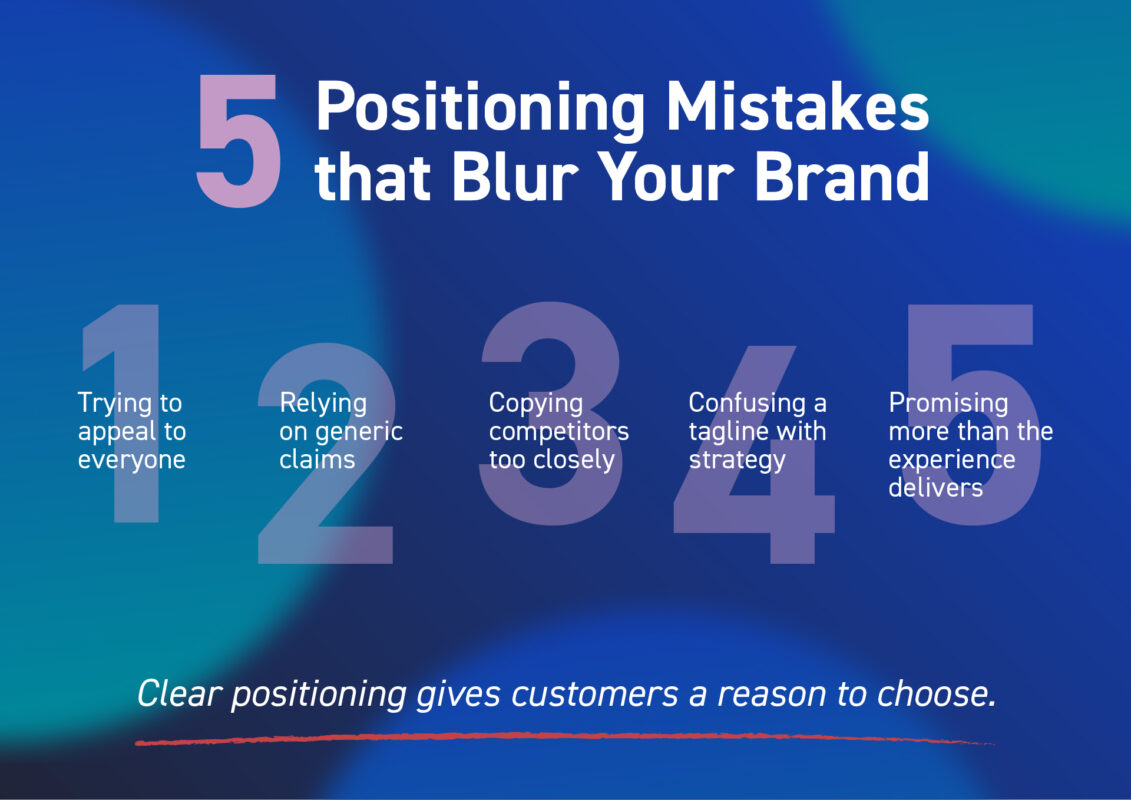
Mistake 1: Trying to Appeal to Everyone
A broad target market may seem commercially attractive, but speaking to everyone often produces messaging that resonates with no one. Claims such as “solutions for businesses of all sizes” reveal little about the needs the brand is best equipped to address.
Why This Weakens the Brand
An undefined audience makes it difficult to prioritise benefits, messages and channels. A start-up seeking flexibility may value different qualities from a large corporation focused on governance, scale and risk management.
Trying to satisfy every segment can also blur decisions about products, services and customer experience.
How to Avoid It
Identify the audience segments that best align with the organisation’s capabilities and growth objectives. Consider their needs, behaviours, frustrations and purchasing criteria.
The brand does not need to exclude other customers, but it should define a primary audience to guide its positioning. This makes the message clearer, more relevant and easier to remember.
Mistake 2: Positioning the Brand Around Generic Claims
Many organisations describe themselves as reliable, innovative, customer-focused or committed to quality. These qualities may matter, but they rarely create differentiation because competitors make the same claims.
Why Generic Claims Are Difficult to Own
Generic positioning gives customers little reason to choose one brand over another. Without evidence, words such as “innovative” or “customer-focused” remain broad statements rather than credible advantages.
When every competitor sounds similar, customers are more likely to decide based on price, convenience or familiarity.
How to Avoid It
Turn broad claims into specific, defensible benefits. Responsive service might mean a guaranteed response time, a dedicated account team or specialist support for a particular sector.
Innovation should be supported by proprietary technology, a distinctive process or a demonstrably better solution. Strong positioning relies on differences customers can recognise and the organisation can prove.
Mistake 3: Copying Competitors Too Closely
Competitor analysis should reveal market gaps, not provide a template to imitate. Yet many businesses adopt the same language, promises and visual conventions as others in their sector.
When every company claims expertise, trust or transformation, meaningful distinction disappears.
Why Competitor-Led Positioning Creates Similarity
Focusing too closely on competitors can cause an organisation to overlook its own strengths, culture and customer relationships. Positioning becomes reactive, changing whenever a competitor launches a new message or campaign.
Familiar category language may feel safe, but familiarity alone rarely creates preference.
How to Avoid It
Use competitor research to identify crowded positions and under-served customer needs. Review competitors’ promises, proof points and customer experiences to find where gaps remain.
Then examine the organisation’s own heritage, specialist knowledge, operating model and proprietary capabilities. Customer interviews may also reveal frustrations that competitors have overlooked.
Mistake 4: Confusing a Tagline with a Positioning Strategy
A tagline is a concise expression of the brand. Positioning is the strategic thinking that defines what the brand should stand for and why it matters.
A memorable phrase cannot compensate for an unclear audience, weak differentiation or an unsupported value proposition.
Why the Distinction Matters
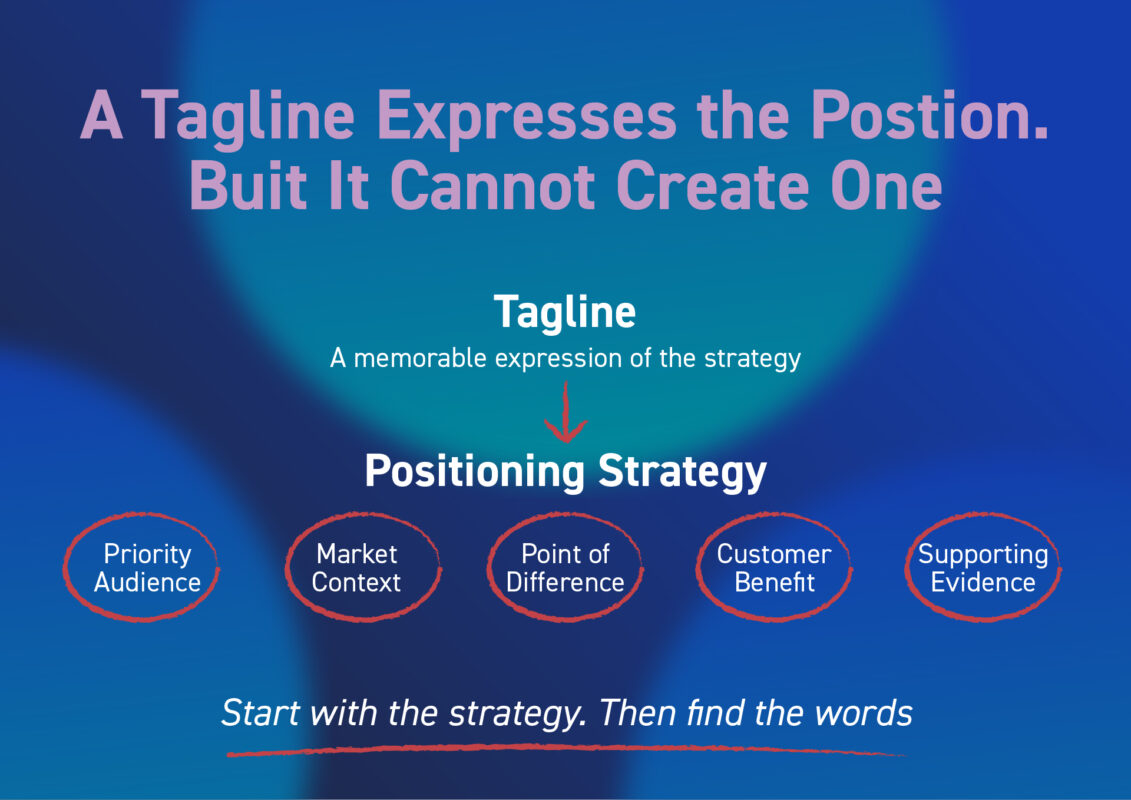
Organisations may spend too much time debating slogans before agreeing on the audience, competitive context or customer benefit. This often leads to inconsistent campaigns and different interpretations across departments.
A tagline can express the position, but it cannot create one.
How to Avoid It
Develop the positioning framework before writing customer-facing language. It should define the priority audience, market context, point of difference, customer benefit and supporting evidence.
Once these elements are clear, they can guide messaging, visual identity and campaigns. The strongest tagline is not necessarily the cleverest, but the one that expresses the strategy clearly and memorably.
Mistake 5: Failing to Align Positioning with the Customer Experience
Customers form opinions through every interaction, not only through advertising. A premium brand may offer a confusing purchase process, while an innovative company may rely on outdated digital systems.
When the experience contradicts the promise, the positioning loses credibility.
Why Misalignment Damages Trust
Customers judge whether the organisation’s behaviour supports its claims. Marketing may create expectations, but service delivery determines whether those expectations are met.
Employees also play a central role. They must understand the intended position and how it should shape their decisions, communication and behaviour.
How to Avoid It
Audit the full customer journey, from initial awareness to purchase, delivery and after-sales support. Assess whether each touchpoint reinforces or undermines the intended position.
An accessible brand should use clear language, simple processes and convenient channels. A premium brand should demonstrate quality through its service, materials, environment and attention to detail.
Positioning becomes credible when customers can experience it, not merely read about it.
How to Test Whether Your Brand Positioning Is Working
Assess the positioning against the following criteria:
| Criterion | What to Check |
| Relevant | Does the position address a genuine need, priority or aspiration among the target audience? |
| Distinctive | Can customers clearly explain how the brand differs from its main alternatives? |
| Credible | Does the organisation have evidence, capabilities or experience to support its promise? |
| Consistent | Is the position reinforced across messaging, products, services and customer interactions? |
| Sustainable | Can the brand maintain the position as it grows, or could competitors easily copy it? |
Testing methods may include internal workshops, competitor audits, customer interviews and perception studies. Employees should be able to explain the position clearly, while customers should recognise its intended benefits without relying on internal branding terminology.
If the assessment reveals gaps, the next step is to build or refine the positioning framework itself.
Building a Stronger Brand Positioning Framework
A stronger positioning process begins with the organisation’s commercial objectives. The business must understand where it intends to grow, which audiences it wants to attract and what role the brand should play in supporting that direction.
The next stage is customer and market research. This involves examining audience needs, perceptions, purchasing criteria and existing alternatives. Competitor analysis should identify crowded claims and potential areas of differentiation.
The organisation can then define a position that is relevant to customers and supported by its actual capabilities. This should include credible proof points rather than aspirational statements alone.
The positioning must then be translated into messaging, visual identity, products, services and customer experience. Internal teams should understand how it affects their work and what behaviours are required to support it.
Professional guidance on brand strategy and positioning can help organisations connect research, commercial priorities and creative execution within one coherent framework.
When Should a Business Revisit Its Brand Positioning?
Positioning should not change whenever a campaign underperforms or a competitor shifts its message. Frequent changes weaken recognition and can confuse both customers and employees.
A review may be needed when the organisation enters a new market, expands its services, targets a different audience or faces changing customer expectations. Mergers, acquisitions and major changes in leadership or business model can also make the existing position less relevant.
Any review should begin with research, not assumptions. Evidence can show whether the issue lies in the positioning itself, how it is communicated or how consistently it is delivered.
Clear Positioning Creates More Consistent Decisions
Effective positioning gives customers a clear reason to choose a brand. It also provides internal teams with a shared basis for making decisions about messaging, products, services and customer experience.
Effective positions are focused, relevant, credible and supported by the organisation’s actual behaviour. They do not depend on generic claims or temporary campaign ideas.
Organisations that need to clarify or strengthen their market position can contact EQ Brand to discuss brand research, positioning development and implementation. Book a consultation with our brand strategy team to explore how a focused positioning framework can support your commercial
Frequently Asked Questions
How is brand positioning different from a value proposition?
A value proposition explains the benefit a customer receives from choosing a particular product, service or organisation. It may focus on practical outcomes, emotional benefits or the problem being solved.
Brand positioning defines how the organisation wants to be perceived relative to competing alternatives. It considers the target audience, market context, point of difference and evidence supporting the claim.
A company may develop several value propositions for different services or customer segments while maintaining one overarching brand position. Both elements should support one another, but they answer different strategic questions.
Can a company have different positioning for different audiences?
A company can adjust its messaging and emphasise different benefits for separate audience groups. For example, a business customer may care about efficiency and risk reduction, while an end consumer may respond more strongly to convenience or personal value.
However, the underlying brand position should remain coherent. Presenting completely different identities or promises to each audience can create confusion and weaken recognition.
Where audiences have fundamentally different needs, the organisation may require a formal brand architecture involving sub-brands, product brands or distinct business units. This allows tailored positioning without compromising the clarity of the parent brand.
How often should brand positioning be reviewed?
Brand positioning should be monitored regularly but does not need to be rewritten every year. A strong position is intended to provide long-term strategic direction rather than respond to short-term marketing trends.
A formal review is appropriate when the market, customer base or business model changes significantly. It may also be necessary when awareness is strong, but customers misunderstand the brand or struggle to explain what makes it different.
Routine reviews can assess whether the position remains relevant and credible. This allows the organisation to refine its expression or implementation without abandoning the strategic foundation unnecessarily.
Can customer research challenge the positioning preferred by management?
Yes. Leadership may have a clear ambition for the brand, but customers may perceive the organisation differently or place greater value on benefits that management has overlooked.
Research can reveal gaps between the desired position and the existing market perception. It may also show that a proposed claim is not sufficiently relevant, distinctive or believable.
This does not mean that customer opinion should dictate every strategic decision. Management must still consider the organisation’s future direction and capabilities.
However, positioning developed without external evidence risks reflecting internal preferences rather than genuine market opportunities.
Should positioning be finalised before developing a visual identity?
The strategic position should normally be established before the visual identity is developed. Positioning provides direction for the personality, messages and associations that the visual system needs to communicate.
Beginning with design may result in an identity that looks attractive but does not express a meaningful idea or support the organisation’s commercial goals. Subsequent strategic changes may then require significant redesign work.
The positioning does not need to prescribe every creative decision. Instead, it should provide a clear strategic foundation that designers can interpret through typography, colour, imagery, layout and other identity elements.

